Virtual Reality
Category
Virtual Reality
Sectors
Healthcare
Video
Objective
Train physicians and improve patient outcomes using medical VR Training programs to better diagnose and treat women and babies. This included minimizing medical resources, time, and money through the creation of efficient and impactful solutions.
Approach
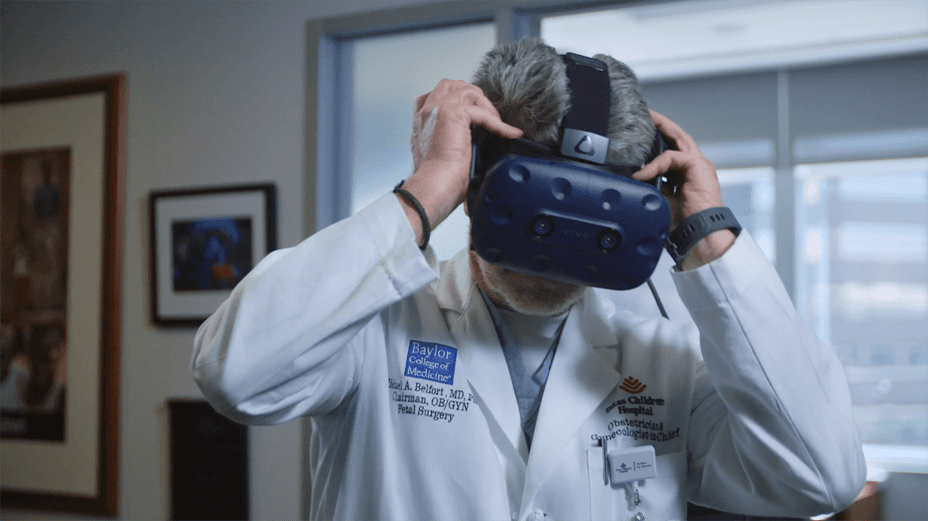
Our team deployed a Virtual Reality (VR) Training Module for the PAS procedure for surgical staff using an immersive VR Headset experience. The training modules were applied in a safe and realistic environment whereby better diagnoses could be achieved for women and babies.
The Problem
We were presented with the challenge of developing solutions to better combat and treat Placenta Accreta Spectrum (PAS) for women and babies. Our task required a robust understanding of the needs of the client and their patients while also presenting solutions that could be effective and immersive. Moreover, our challenges were compounded by the need to maintain minimal time, cost, and medical resource expenditures.
This life-threatening condition currently affects approximately 1 in every 1,000 mothers and babies. Although the rate of PAS diagnoses in women and babies continues to rise, medical staff often lack sufficient awareness and training for procedures to treat this condition. Within the healthcare industry, the need for cost-effective and labor-saving technologies is paramount, which is why we were tasked with the creation of an immersive medical VR training program for these surgical procedures.
The Solution
Medical VR Training Simulation for PAS Procedure
SHIIFT developed an immersive and realistic medical VR training program for the PAS procedure. The VR program consists of a virtual surgical operating theater complete with an operating table, medical apparatuses, equipment, a patient, and medical staff. This immersive environment is made realistic through the use of shade and lighting, which graphically mimics real-world surgical settings and enables surgeons to perform realistic surgical procedures, all in a safe VR environment. The VR headset itself is a convenient tool that fits over the head comfortably. This enables the medical VR training to take place in clinics, hospitals, or wherever the surgical staff are.
The Medical VR Training experience allows surgical staff to learn, develop, and practice their skills and knowledge in a safe, realistic environment. This training program yields strong and impactful results on the ability of surgical staff to diagnose and treat PAS, thereby saving the lives of women and their babies. Our solution was designed to protect the health and wellbeing of patients undergoing PAS surgical procedures. It also reduces medical expenditures and saves time, freeing up medical resources, all while minimizing the occurrence of mistakes in real surgical operations.
When was this project completed?
The project was fully completed and deployed in September 2020 and surgical staff at the Baylor College of Medicine were able to take advantage of the Medical VR Training immediately.
How Long did it take?
The entire medical training VR project took one month to complete, from the start of the contract until the successful deployment of the VR solution to surgical staff at the Baylor College of Medicine.
DeVELOPMENT ENGINE
This project was completed using the real-time game development platform Unity, which is one of the most successful and most widely known development engines for modern 3D games as well as Virtual Reality (VR) and Augmented Reality (AR) solutions.
Which services did you use for this? Was it just VR?
Our team consulted with other medical training VR experience solutions that have been used for training doctors on surgical procedures, as well as consulting with the Baylor College of Medicine to better understand the problem (PAS) and to develop robust solutions through VR.

Gallery
PROJECTS YOU MIGHT BE INTERESTED IN
See all work

